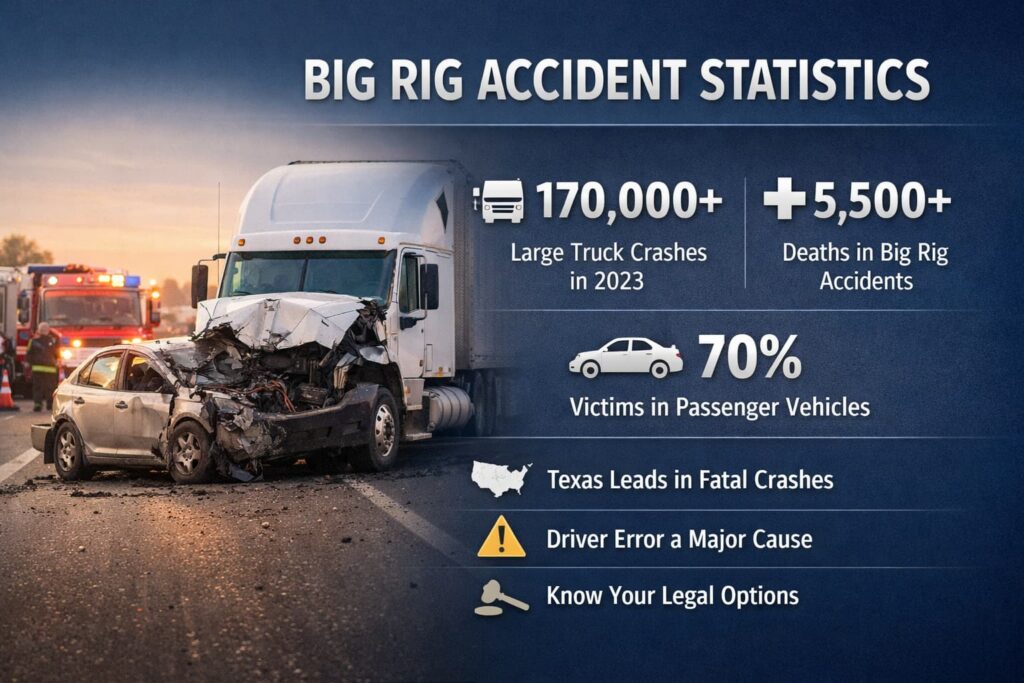
More than 170,000 large truck crashes occurred across the United States in 2023, resulting in nearly 5,500 deaths. Despite safety regulations and advances in vehicle technology, big rig accident statistics show a troubling rise in fatal collisions over the past decade.
Most of the victims aren’t truck drivers. They’re people in smaller vehicles who never saw it coming. The latest federal data reveals not just how often these crashes happen, but who pays the highest price when things go wrong.
If you or someone you love was harmed in a big rig crash, a skilled truck accident attorney can review your case and fight for accountability—contact us today for a free consultation.
Request Your Free Consultation
Key Takeaways for Big Rig Accident Statistics
- More than 70% of people killed in these crashes were in passenger vehicles, not trucks.
- Texas consistently reports the most truck-related fatalities, with over 700 fatal crashes involving big rigs in one recent year.
- Federal agencies such as the FMCSA and NHTSA cite truck driver behavior in nearly 87% of fatal large truck collisions.
- Truck accident injuries often lead to long-term physical, emotional, and financial consequences.
Big Rig Accident Statistics in the United States
According to the most recent federal data, more than 170,000 large truck crashes occurred in one recent year nationwide. Between 4,800 and 5,500 people were killed as a result of these crashes, making up roughly 13% of all US traffic deaths that year. That’s a significant increase from a decade ago, reflecting both increased freight activity and ongoing safety challenges.
Most truck accident victims are not truck drivers. Tractor-trailers and other big rigs weigh up to 30 times more than the average passenger vehicle, so it’s no surprise that collisions often cause catastrophic injuries to the occupants of the smaller vehicles.
About 70% of those killed were occupants of other vehicles, while truck drivers and passengers accounted for just 16–17%. The rest included motorcyclists, pedestrians, and cyclists.
Which States Are the Riskiest for Big Rig Accidents?
Texas has consistently reported the highest number of fatal truck crashes in the country—and by a wide margin. In 2023, 705 fatal crashes in Texas involved large trucks, accounting for nearly 13% of all truck-related deaths nationwide.
California, Florida, and Georgia round out the top four, but none come close to matching Texas’s numbers. The reasons go beyond population size.
Several factors help explain why Texas sees so many big rig accidents:
- An expansive highway system includes major national freight corridors such as I-10, I-35, and I-45
- Heavy commercial trucking volume tied to oil, gas, agriculture, and cross-border trade
- Long distances between cities, increasing driver fatigue and hours behind the wheel
- Rapid growth in urban areas like Houston and Dallas, leading to traffic congestion and mixed vehicle types
With so many trucks on the road each day, the risk of serious crashes remains high across the state. These dangers are part of daily life for Texas drivers, especially in freight-heavy regions.
What Causes Most Large Truck Accidents?
The Federal Motor Carrier Safety Administration (FMCSA) has studied crash causes for years. In the most recent data, the agency has identified a clear trend: human error is the leading factor in big rig crashes.
Here’s what stands out:
- Driver fatigue, including falling asleep at the wheel, contributed to about 7% of fatal accidents.
- Distractions, including phone use and in-cab electronics, played a significant role.
- Driver unfamiliarity with the route was noted in 19% of investigated crashes.
- Speeding, tailgating, and unsafe lane changes also appear frequently in police and agency reports.
- Brake problems were cited in up to 27% of crashes; in many cases, the defects were severe enough to remove trucks from service. This alarming fact underscores the massive problem of poorly maintained and inspected vehicles.
Mechanical issues and environmental conditions, such as tire blowouts or fog, also contribute, but less often.
Trends and Patterns in Truck Accident Data
Looking closer at when and where these crashes happen reveals patterns that can help reduce risk.
- Weekday crashes dominate the data. About 76% of all fatal truck collisions occur between Monday and Friday.
- Daylight hours see the most incidents, likely due to increased traffic and delivery schedules.
- Both rural and urban highways are affected, though rural interstates tend to see more fatal crashes due to higher speeds and longer stopping distances.
These patterns reflect the nature of freight movement in the US, with truck drivers often pushing long hours to meet demanding schedules.
Request Your Free Consultation
Fatalities and Injuries in Semi-Truck Crashes
Truck crashes don’t just take lives—they often cause serious injuries that require months or years of recovery. In one recent year, between 74,000 and 86,000 people were injured in crashes involving big rigs.
Many survivors experience:
- Traumatic brain injuries (TBIs)
- Spinal cord damage or paralysis
- Broken bones requiring surgery
- Severe burns or lacerations
- Permanent disfigurement or mobility issues
The long-term impact extends well beyond physical harm. Many people live with emotional trauma, financial stress, and lifestyle changes that alter their careers and relationships.
Compensable Damages in Truck Accident Claims
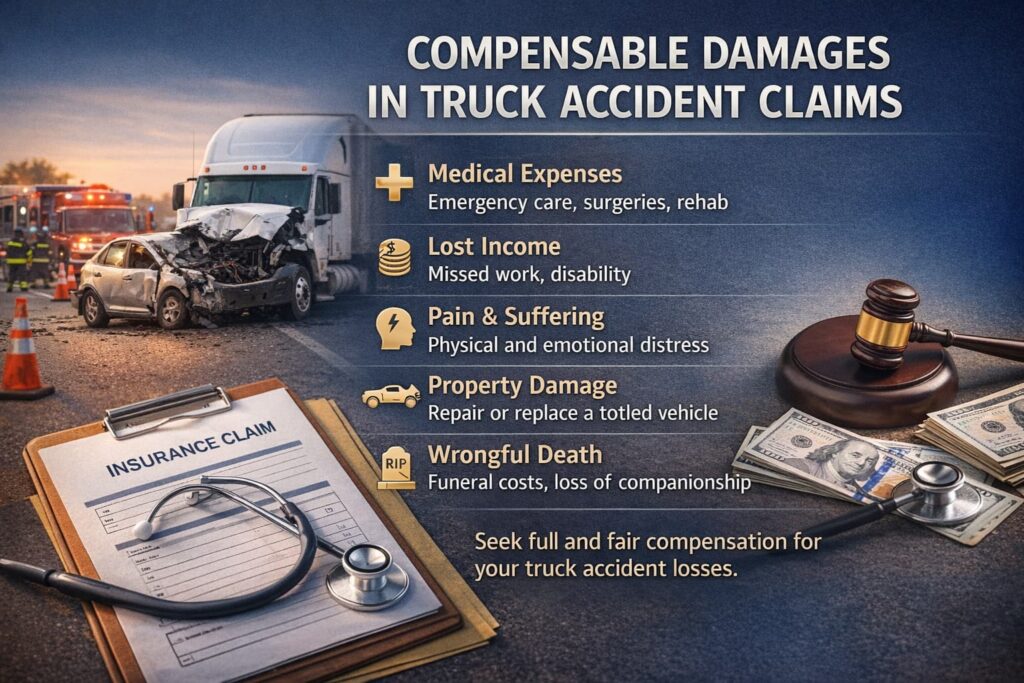
If you’ve been hurt in a truck crash caused by someone else’s actions or negligence, you may be able to pursue compensation for your losses. Trucking companies and their insurers are often quick to protect their bottom line, but victims have legal rights too.
Common categories of recoverable damages include:
- Medical costs for emergency care, surgeries, rehab, and future treatments
- Lost income due to missed work or disability
- Pain and suffering, both physical and emotional
- Property damage for totaled vehicles or belongings
- Wrongful death-related losses, such as funeral costs and loss of companionship
The amount available varies based on the severity of injuries, available insurance coverage, and fault determination.
FMCSA and NHTSA Data on Truck Safety
2 agencies—the FMCSA and the National Highway Traffic Safety Administration (NHTSA)—track and publish truck safety data. According to their findings:
- Fatal truck crashes have risen 64% since 2009
- Fatalities have increased 87% over the same period
- Truck drivers are involved in 1.3 fatal crashes per 100 million miles, which is lower than passenger vehicles but still significant
- 42% of trucks involved in crashes had brake defects bad enough to warrant inspection failure
These statistics point to two major issues: vehicle maintenance and driver behavior. Despite strong regulations, enforcement gaps persist, especially when trucking companies push drivers to meet unrealistic deadlines.
FAQs for Semi-Truck Accident Statistics
What is the most common type of big rig accident?
Rear-end collisions, jackknife accidents, and rollovers are among the most common. Each carries a high risk of severe injury due to the truck’s size and force.
Are truck drivers often at fault in these crashes?
FMCSA data shows driver-related actions contributed to up to 87% of fatal crashes. However, each case must be investigated based on its facts.
Do weather conditions increase truck crash risk?
Yes. Rain, ice, and fog can make it harder for trucks to stop or maintain control, especially on long-haul routes. Many weather-related commercial truck crashes occur because the driver failed to adjust their driving for road and environmental conditions.
How do government agencies track these statistics?
The FMCSA and NHTSA collect data from crash reports, inspections, and safety audits. This information is updated annually and often used to adjust safety regulations.
Are fatal truck crashes becoming more common?
Yes, long-term data show a steady increase in fatal truck crashes since 2009, despite improvements in vehicle safety technology.
How are big rig accidents investigated after a crash?
When a crash involves a commercial truck, federal and state agencies may conduct a more detailed review, especially if there are fatalities or serious injuries. Investigators typically examine driver logs, black box data, maintenance records, and crash scene evidence to determine whether safety violations, fatigue, or mechanical failures played a role. These investigations can take weeks or months and often influence legal claims and liability decisions.
Getting Help After a Big Rig Accident
If you or someone you love has been seriously injured in a truck crash caused by a negligent truck driver, you have legal options. At Terry Bryant Accident & Injury Law, our team of Texas truck accident lawyers fights for people who’ve been seriously harmed in 18-wheeler and big rig crashes. We serve clients throughout Houston and the surrounding areas, and we’re proud to stand up for those who need a strong advocate.
We know Texas roads. We know trucking regulations. And we know how to build a case that reflects the true cost of a devastating crash.
Call us now at (713) 973-8888, or toll-free 1 (800) 444-5000, you may also contact us online for a free and confidential truck accident case review. Let’s talk about how we can fight for your maximum compensation and help you move forward.