Truck accidents in Texas often lead to life-altering injuries or tragic losses. Figuring out what your case may be worth isn’t simple. It depends on several specific factors. Unlike minor collisions, commercial truck crashes usually involve more serious harm, higher insurance limits, and deeper investigations.
If you're looking for answers about Texas truck accident settlements and verdicts, know that every case is different. Still, certain patterns emerge. Factors like the severity of injuries, who was at fault, and how much insurance is available often shape the final outcome. This guide explains what affects case value and what you need to know when pursuing compensation after a serious truck wreck.
If you’re wondering what your claim may be worth, a skilled Houston, TX truck accident lawyer can evaluate your case and fight for fair compensation—contact us today for a free consultation.
Request Your Free Consultation
Key Takeaways About Texas Truck Accident Settlement Amounts
- Truck accident settlements in Texas depend heavily on injury severity, liability, and insurance limits.
- Truck accident victims may seek compensation for economic and non-economic damages, with dollar values tied to their specific injuries and losses.
- Cases involving catastrophic injuries or wrongful death typically result in higher compensation.
- Texas applies a modified comparative negligence rule that adjusts compensation in shared fault cases.
- Evidence like black box data, trucking logs, and Federal Motor Carrier Safety Administration (FMCSA) violations can strengthen your claim.
- Punitive damages may apply in rare cases involving gross negligence or reckless conduct.
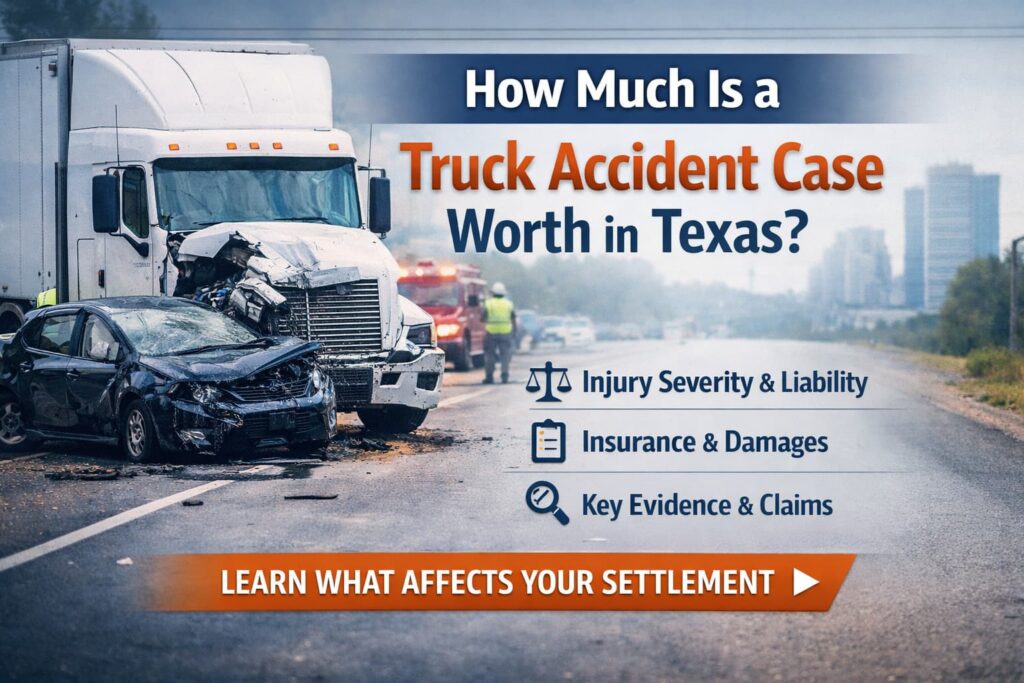
Factors That Affect the Value of a Texas Truck Accident Case
Several key factors influence the value of a Texas truck accident claim. When injuries are serious or a life has been lost, the legal and financial stakes are much higher. A basic knowledge of what affects compensation can help prepare you for the road ahead.
Injury severity and long-term impact
More serious injuries often result in higher settlements. Claims involving brain trauma, paralysis, amputations, or burns may require long-term care, assistive devices, or lifelong treatment. The impact on your daily life plays a major role in valuation.
Liability and shared fault
Texas follows a modified comparative negligence rule under Texas Civil Practice and Remedies Code § 33.001. If you’re found to be partially at fault, you can still recover compensation as long as you’re less than 50% responsible, but it will be reduced by your percentage of fault. An experienced Texas truck accident lawyer can shield you and your claim from any attempts to shift undue fault to you for the accident.
Insurance policy limits
Trucking companies usually carry commercial liability policies with higher coverage limits than personal vehicles. But even those limits might not cover the full extent of serious or fatal injuries. In many cases, more than one party may be liable, and each may have a separate insurance policy. Identifying all available sources of compensation early in the case is essential to pursuing the full value of your claim.
Documentation and evidence
The strength of your evidence can directly affect your case value. This includes photos, videos, crash reports, medical records, and witness statements. For commercial truck crashes, it may also involve:
- Black box data showing speed, braking, and engine activity
- Driver logbooks and hours-of-service violations
- Maintenance records and inspection reports
- Surveillance footage and dashcam video
Proper documentation not only proves your injuries but also supports liability and potential regulatory violations.
Types of Damages You May Recover in a Texas Truck Accident Case
Damages in a truck accident case are generally divided into 2 broad categories: economic and non-economic. In certain cases, punitive damages may also apply.
Economic damages
These are the direct financial costs you’ve incurred. A full accounting of these losses can significantly increase your potential settlement.
- Medical bills (past and future)
- Lost wages from missed work
- Loss of future earning capacity
- Rehabilitation, physical therapy, or long-term care
- Property damage (vehicle repair or replacement)
Non-economic damages
These compensate for more personal losses that don’t come with receipts. They’re harder to quantify but often play a large role in serious injury cases.
- Physical pain and suffering
- Emotional distress and anxiety
- Loss of enjoyment of life
- Disfigurement or permanent disability
- Loss of companionship (in fatal cases)
Can Punitive Damages Increase Case Value?
Punitive damages are rare but may significantly increase a truck accident case’s value if awarded. These damages are not tied to your injuries, but rather to the defendant’s behavior. Texas law allows punitive damages only when gross negligence or willful misconduct is clearly proven.
For example, a court may consider punitive damages if:
- A trucking company hired a driver with a known history of DUIs
- A driver operated a vehicle far beyond legal hours without rest
- Safety violations or falsified logs were knowingly ignored
Punitive awards aim to send a message and deter future misconduct. Because they require a higher burden of proof, they are typically sought in litigation, not in early settlement negotiations.
Common Types of Serious Injuries from Truck Accidents
Large commercial trucks often weigh 20–30 times more than passenger vehicles. When collisions happen, the results can be catastrophic. Serious injuries tend to increase a claim’s value, but also increase the burden of proof and documentation.
Some of the most serious injuries associated with 18-wheeler wrecks include:
- Traumatic brain injuries (TBIs): Can cause permanent cognitive, speech, or motor impairments
- Spinal cord damage: May result in paralysis or loss of mobility
- Amputations: Common in high-impact crashes or rollovers
- Burns and disfigurement: May require multiple surgeries or result in permanent scarring
- Internal injuries: Including damage to organs that may not be immediately visible
Victims of these injuries often require long-term care or lifelong accommodations. These future costs play a significant role in how a claim is evaluated.
How Settlements Are Calculated in Serious Truck Accident Cases
No fixed formula determines what a case is worth, but certain calculations help guide negotiations. A careful assessment of current and future losses is essential.
Here’s how damages are typically calculated:
- Medical expenses: Including hospital stays, surgeries, rehabilitation, and projected future costs
- Lost wages: Based on your current earnings and how long you’re unable to work
- Loss of earning potential: If your injuries limit your ability to return to your previous job
- Pain and suffering: Based on how the injury affects your quality of life
Your legal team may work with medical experts, vocational economists, and life care planners to establish a solid estimate of your losses.
Insurance Limits and Their Role in Truck Accident Case Value
Even when injuries are severe, insurance coverage can cap the amount recoverable. Identifying all responsible parties is a challenging but vital part of truck accident investigations.
Trucking companies may carry high-limit policies, but other entities might also be liable:
- The truck driver (if an independent contractor)
- The trucking company
- A third-party maintenance provider
- The manufacturer of a defective part
When multiple parties are involved, their combined insurance limits can increase the total compensation available.
In Texas, most commercial trucks are subject to federal insurance minimums set by the FMCSA. For example, a truck transporting non-hazardous freight across state lines must carry at least $750,000 in liability insurance under FMCSA regulations.
Request Your Free Consultation
What If You’re Partly at Fault in a Texas Truck Accident?
Even if you think you may have contributed to the crash, that doesn’t mean you lose your right to pursue compensation. Texas law recognizes that accidents are rarely black and white. The state uses a modified comparative fault system, which allows injured individuals to recover damages as long as they are no more than 50% at fault.
In other words, you may still be eligible for compensation—even if you played a role in what happened. The key is to make sure your share of responsibility isn’t overstated by the other side.
Here’s why working with a lawyer is especially important in these cases:
- Insurance companies may try to shift more blame to you to reduce what they have to pay.
- A legal team can help gather evidence, such as black box data, traffic footage, or safety violations, to show the truck driver or company shares responsibility.
- Experienced attorneys can challenge unfair claims of fault and push back on inaccurate narratives.
Partial fault does not end your claim, but it does make strong legal representation all the more important. An attorney can help make sure fault is assessed fairly, and that your case reflects the full scope of the truck driver’s and the truck carrier’s responsibilities.
How Evidence Influences Case Value
In truck accident litigation, evidence is more than proof of fault—it helps paint the full picture of your losses and supports the demand for higher compensation.
Key pieces of evidence may include:
- Black box data: Captures speed, brake use, and engine activity leading up to the crash
- Trucking company records: Including maintenance logs, inspection reports, and driver logs
- Photographic and video evidence: Damage to vehicles, skid marks, injuries, and the crash scene
- Police reports and citations: May support fault determinations or traffic violations
- Medical documentation: Includes ER visits, diagnostics, surgeries, rehab, and ongoing care
The more compelling your documentation, the stronger your claim becomes during settlement talks or trial. Gathering and preserving this evidence early on helps avoid gaps that could weaken your case.
How Long Do Truck Accident Cases Take to Settle in Texas?
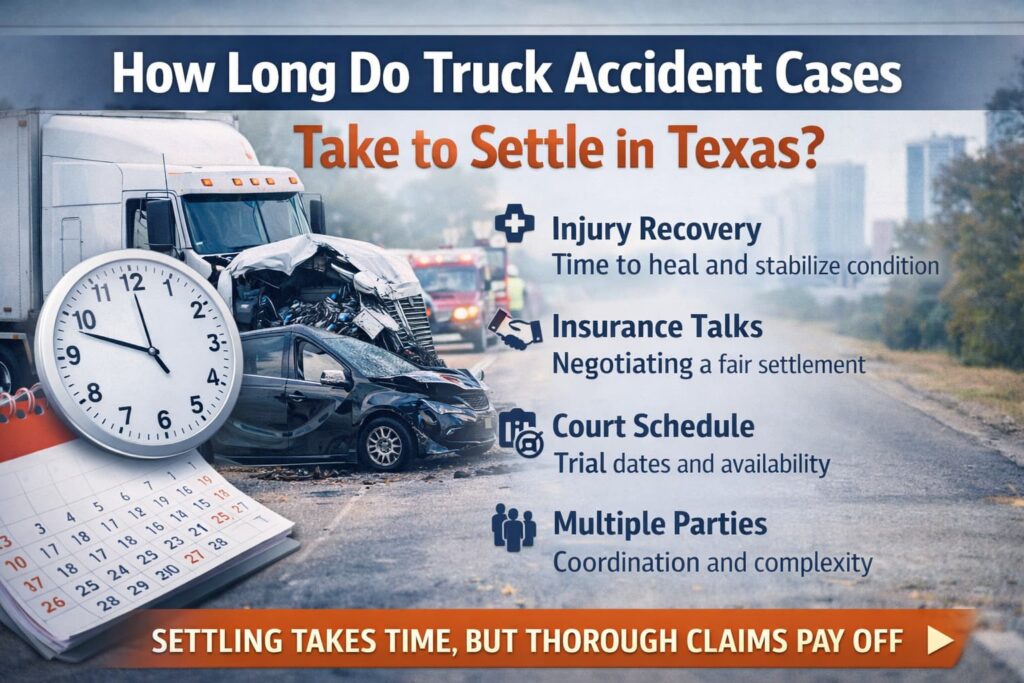
Truck accident cases vary in how long they take, but many resolve in less time than people expect. Some settle within several months, while others may take longer if injuries are severe or liability is disputed. What matters most is reaching a fair resolution that protects your future, not rushing into an agreement that leaves you struggling later.
Factors that often influence settlement timelines include:
- Injury recovery: Waiting until your condition stabilizes ensures that future medical care is included in the claim.
- Insurance negotiations: Carriers may attempt to minimize payouts, but persistence helps secure fair compensation.
- Court schedules: If a case moves to trial, court availability may add time, but strong evidence often encourages settlement before trial.
- Multiple parties involved: When more than one company or insurer is responsible, additional coordination may be required.
Even if the process takes longer, there is a clear benefit: a thorough, well-prepared claim often results in stronger settlements. Taking the time to document injuries, gather evidence, and build a case puts you in the best position to recover the resources you need for long-term stability.
What You Can Do to Protect the Value of Your Claim
If you’ve been in a truck accident, chances are you’re already under medical care for your injuries. If you haven’t been evaluated yet, do so as soon as possible. Prompt treatment protects your health and creates the medical documentation needed to support your case. Once your immediate needs are addressed, there are other important steps you can take to strengthen the value of your claim.
Actions that often make a major difference include:
- Hire a lawyer: A truck accident attorney can manage evidence, handle negotiations, and protect your rights from the start.
- Keep every medical appointment: Following through on treatment shows that your injuries are serious and ongoing, and it prevents insurers from challenging the severity of your injuries.
- Document your recovery: Keep a written or video journal of your pain levels, emotional struggles, and daily limitations. These records provide powerful proof of non-economic damages such as pain and suffering.
- Preserve evidence: Save crash photos and videos, damaged property, medical records, along with any communication with insurers. This evidence helps connect the accident to your losses.
- Be cautious with insurers: Do not give recorded statements without legal guidance, as adjusters often use them to reduce claim value.
Taking these steps not only protects your health but also strengthens your position if insurers dispute your injuries or losses. With the right support and documentation, your claim carries more weight in both settlement negotiations and court.
FAQ for How Much Is a Truck Accident Case Worth in Texas?
How do trucking regulations affect the value of my claim?
The FMCSA rules govern everything from driver rest breaks to vehicle maintenance. Violations of these rules can be powerful evidence of negligence and may increase your chances of recovering compensation.
Is wrongful death compensation different from injury claims?
Yes. In Texas, wrongful death claims may include compensation for lost income the deceased would have earned, funeral expenses, and loss of companionship. These cases are typically brought by surviving family members and follow a different legal structure
Can I sue more than one party in a truck accident case?
Often, yes. Liability may fall on multiple parties, including the driver, trucking company, maintenance providers, or even a parts manufacturer. Naming all liable entities can help increase the potential recovery pool.
How does future medical treatment factor into my settlement?
When injuries require ongoing care, settlements may include projections for future surgeries, therapy, medications, or assistive devices. Your lawyer may bring in a medical expert or life care planner to help estimate these costs.
Will my case go to trial?
Most truck accident claims settle out of court, but some do proceed to trial, especially if there are serious injuries and large amounts at stake. Litigation may become necessary if the insurance company denies fault or refuses to offer fair compensation.
Need Help After a Serious Truck Accident in Texas?
Recovering from a truck accident takes every ounce of energy you have. Between painful treatments, medical bills, and the emotional toll on your family, the last thing you should worry about is paperwork or insurance negotiations.
At Terry Bryant Accident & Injury Law, we put our full resources into protecting injured Texans and their families. Our team knows how much is at stake when a crash leaves you facing long-term recovery or grief. We focus on building strong cases so you can focus on healing.
If you or someone you love has been seriously hurt in a crash involving an 18-wheeler, semi-truck, or other commercial vehicle, call us now at (713) 973-8888 or toll-free 1 (800) 444-5000, you can also contact us online for a free and confidential case review. We’ll listen to your story, explore your options, and take on the legal burdens so you can move forward.