Losing someone you love in a car accident is a traumatic loss and shock that impacts every part of your life. When someone else’s actions cause that loss, it often adds another level of emotional pain and brings legal questions no one is prepared to ask.
If you're trying to understand your legal options after a fatal car accident, the decisions ahead may feel heavy, but you don’t have to make them blindly. Taking legal action isn’t about revenge. It’s about honoring your loved one’s life and finding the support your family needs to move forward.
The law can’t undo what happened, but it can offer a path forward when everything else feels uncertain.
If your family is facing the loss of a loved one, a compassionate car accident lawyer can explain your legal options and help you seek justice—contact us today for a free consultation.
Request Your Free Consultation
Key Takeaways About Legal Options for Families After a Fatal Car Accident
- Wrongful death claims allow close family members to pursue compensation after a fatal crash caused by negligence.
- Each state, including Texas, has its own rules about which family members can file wrongful death lawsuits.
- Damages may include medical bills, funeral costs, lost income, pain and suffering, and loss of companionship.
- Legal options may include using uninsured/underinsured motorist coverage or pursuing third-party liability if the at-fault driver lacks adequate insurance.
- Some claims may also involve estate claims or survival actions in addition to wrongful death.
Legal Grounds for Filing a Fatal Car Accident Lawsuit
Texas recognizes wrongful death when a person dies because of another’s wrongful act, neglect, carelessness, or unskillfulness, as defined in Texas Civil Practice and Remedies Code Chapter 71:
- Drunk or impaired driving
- Speeding or reckless behavior
- Distracted driving (such as texting)
- Failing to yield or obey traffic laws
- Driving while fatigued
To move forward with a claim, there must be evidence showing the crash was caused by someone else’s negligence. This could come from police reports, witness accounts, traffic camera footage, or expert analysis.
While Texas law does place the burden of proof on the family, you don’t have to carry that weight alone. A qualified attorney can take the lead in gathering and presenting the evidence so you can focus on grieving and healing.
Types of Injuries That May Lead to a Wrongful Death Claim
Not every fatal crash results in an immediate loss. Some victims pass away days or even weeks later due to complications from their injuries. Families often wonder whether they can still pursue a claim in these circumstances. The answer is often yes.
Some of the most serious car crash injuries include:
- Traumatic brain injuries (TBIs) that lead to loss of function or coma
- Spinal cord injuries with paralysis or internal trauma
- Severe burns or crush injuries
- Multiple organ failure after blunt force trauma
- Secondary complications, such as infections or brain swelling
Wrongful death claims can apply whether death occurred at the scene or after medical intervention. What matters most is that the fatal injuries were caused by the other party’s actions.
When you’ve lost someone in this way, it’s more than a legal case. It's an irreplaceable loss, and we never forget that. Behind every claim is a grieving family trying to make sense of something that should never have happened.
What Kind of Compensation Can I Get for a Fatal Car Crash?
People often ask us what kind of compensation they can recover after a fatal crash. In Texas, wrongful death claims allow certain family members to seek damages for the personal and financial impact of losing a loved one. These claims focus on the losses experienced by surviving relatives. They include:
- Lost income or financial support the deceased would have provided
- Funeral and burial expenses
- Loss of companionship, care, and emotional support
- Grief, mental anguish, and loss of household services
No amount of money can ever replace someone you love. But pursuing a wrongful death claim can ease the financial strain and hold negligent parties accountable, giving you more space and presence to grieve.
Request Your Free Consultation
What’s the Difference Between a Survival Action and a Wrongful Death Claim?
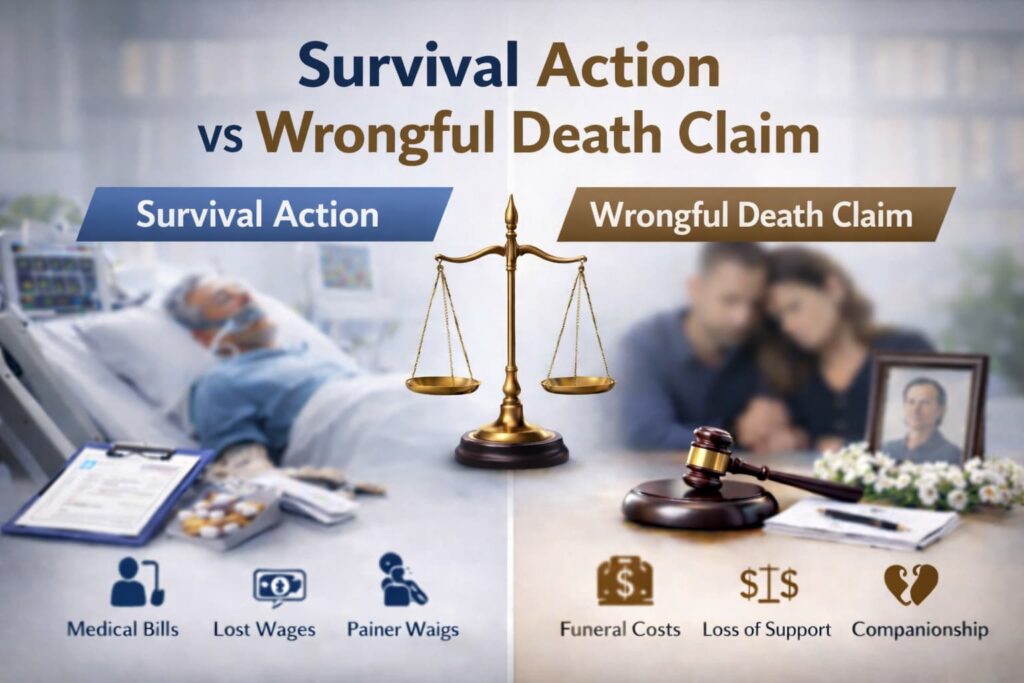
A survival action is a separate legal claim that may apply if the victim survived for any period of time after the crash, even briefly. This type of lawsuit focuses on what the victim personally experienced before death, and any compensation awarded goes to the estate.
Damages available in a survival action may include:
- Medical expenses incurred after the injury but before death
- Pain and suffering the deceased experienced
- Mental anguish or emotional distress that the victim endured
- Lost wages during the period between the crash and passing
Unlike wrongful death claims, which are brought by close family members, survival actions are filed by the personal representative of the estate. Both claims can often be pursued together, but they serve different legal purposes.
These cases can be complex, especially when someone passes away days or weeks after the crash. An experienced attorney can help determine whether both types of claims apply and build a case that honors the full scope of the loss.
Filing a Wrongful Death Lawsuit: What to Expect
Wrongful death claims follow a legal process that involves investigation, evidence gathering, and possibly negotiation or trial. Your attorney will guide you through every phase, which typically includes:
- Identifying all liable parties
- Proving negligence in the crash
- Demonstrating your family’s damages
- Filing the lawsuit in the correct jurisdiction
- Responding to insurance company defenses
- Negotiating a settlement or preparing for trial
Each case has its own timeline and challenges. However, an experienced legal team can handle the logistics while you focus on grieving and rebuilding.
FAQ for Legal Options After a Fatal Car Accident
What if the at-fault driver was uninsured?
Families may still be able to pursue compensation through uninsured/underinsured motorist (UM/UIM) coverage or a third-party claim if other parties contributed to the crash.
Can multiple family members file separate claims?
Texas allows eligible family members to file individually or together, but only one wrongful death claim can be pursued in court. Coordination is key.
What if the victim was partly at fault?
Under Texas’s modified comparative negligence rule, families can recover damages as long as the victim was not more than 50% responsible. Compensation is reduced based on the percentage of fault assigned. Because even a small shift in liability can affect the outcome, it’s important to work with an experienced personal injury lawyer who can help protect your family’s right to fair compensation.
Get Help from a Law Firm That Truly Cares
At Terry Bryant Accident & Injury Law, we've spent over 40 years helping families in Houston and across Texas through the most difficult chapters of their lives. After decades of handling fatal and serious injury cases, we’ve seen the immense toll these tragedies take on families. That experience changes you.
We care because we've worked with families whose lives were turned upside down in an instant. We've heard their stories, witnessed their struggles, and stood beside them in courtrooms. When we fight for someone’s future, we think about our own families and what we’d want someone to do for them.
If you’ve lost a family member in a fatal crash, we’re here to help you explore your legal options after a fatal car accident, without pressure or confusion. If you’re dealing with Texas wrongful death laws or considering a fatal car accident lawsuit, we’ll help you every step of the way.
Call us now at (713) 973-8888 or toll-free 1 (800) 444-5000 or contact us online for a free and confidential consultation.