
Somewhere between the ambulance and the drive home, someone hands you paperwork. A plan name, a claims number, a place to sign. It is not workers' compensation, and nobody says so out loud.
Terry Bryant Accident & Injury Law handles Sam's Club work injury claims across Texas, where state records show the employer operating outside the workers' compensation system and an injured associate's case runs on negligence instead. The first step is a free, confidential review of your paperwork, before you sign anything.
That plan is real, it may pay some of your bills, and it carries terms that decide whether you keep the right to sue.
Terry Bryant Accident & Injury Law offers free non-subscriber work injury case reviews. Call (713) 973-8888 or toll-free 1 (800) 444-5000 now.
On This Page
- What Does Non-Subscriber Status Actually Change?
- How Do Warehouse Club Injuries Happen?
- Should You Sign the Injury Plan Paperwork?
- What Can You Recover?
- How Long Do You Have to Act?
- How These Cases Get Built
Does Sam's Club Carry Workers' Compensation in Texas?
Public state records indicate no. Wal-Mart Associates, Inc. appears in the Texas Division of Workers' Compensation non-subscriber filings, and those filings list Sam's Club locations across Texas, both clubs and distribution centers.
Texas is the only state where private employers can opt out of workers' compensation entirely. An employer that opts out is a non-subscriber and has to tell the state. Those filings are public.
You can look up your own employer. The Texas non-subscriber employer dataset is searchable by company name and address, and the Texas Department of Insurance (TDI) will confirm coverage in writing through its employer coverage page if you send the employer name, the address, and your date of injury.
That fact changes your case, and it works in your favor more than most injured workers realize.
Why Does Walmart's Name Keep Showing Up in Your Claim?

Because Sam's Club is a Walmart company. Walmart Inc.'s own filings with the Securities and Exchange Commission list Sam's West, Inc. and Sam's East, Inc. as wholly owned subsidiaries doing business as Sam's Club.
For an injured associate, that has 3 practical consequences.
The entity that actually employs you may not be the one on the sign outside. Hourly club associates in Texas are frequently employed through a Walmart payroll entity, and the exact name appears on your hire paperwork and pay records. Pull those out first.
The injury plan is a corporate program, not a club-level one. Your club manager did not write it and cannot change it.
And the defense is handled centrally, by a claims operation built to process thousands of injuries a year. Not a reason to walk away, but a reason not to walk in alone.
If your injury happened at a Walmart store rather than a club, our Walmart work injury page covers that side of the same company.
What Does Non-Subscriber Status Actually Change?
It strips the employer of 3 defenses that most Texas defendants get to use. This is the single most valuable thing to understand about your claim.
Under Texas Labor Code §406.033, in a suit against a non-subscribing employer, it is not a defense that:
- the employee was guilty of contributory negligence
- the employee assumed the risk of injury or death
- the injury was caused by the negligence of a fellow employee
In plain terms: the company cannot argue that you should have been more careful, they cannot argue you knew the job was dangerous and did it anyway, and cannot blame the coworker driving the pallet jack.
What you still have to prove is employer negligence. That is the whole case, and it comes down to training, staffing, equipment maintenance, and whether anyone reported the hazard before it hurt you.
A comp claim pays regardless of fault but pays far less and never covers pain and suffering. Non-subscriber cases are harder to win and worth substantially more.
Not sure which employer entity is on your paperwork? Call (713) 973-8888 or toll-free 1 (800) 444-5000 and we will help you understand every bit of the paperwork, in plain simple English.
How Do Warehouse Club Injuries Happen?

Differently from a regular retail store, because a warehouse club is a warehouse that customers walk through. The merchandise is heavier, the racking is higher, and powered equipment runs on the same floor as members.
The patterns we see most:
Falling merchandise from high racking. Steel racking runs well above head height and pallets get restacked constantly. Product that shifts or was loaded wrong comes down on whoever is below.
Pallet jacks and powered equipment. Electric pallet jacks, order pickers, and forklifts in aisles never designed as traffic lanes. Crush and struck-by injuries are common.
Lifting bulk. A shift spent moving 40-pound case packs produces the shoulder, back, and hernia injuries that end careers slowly rather than suddenly.
Freezer and cooler work. Slick floors, ice buildup, cold injuries, and doors that close on people.
Tire and battery center. Impact wrenches, tire cages, vehicle lifts, battery acid. The highest-hazard corner of the building, and often the least staffed.
Fuel center and parking lot. Cart retrieval in Texas summer heat, vehicle strikes, and slips on spilled fuel.
The Bureau of Labor Statistics recorded a nonfatal injury rate of 4.2 per 100 full-time workers in general merchandise stores in 2024, against 2.3 across all private industries, in its industry injury data. Retail is not a safe category, and warehouse-format retail is the least safe part of it.
Should You Sign the Injury Plan Paperwork?
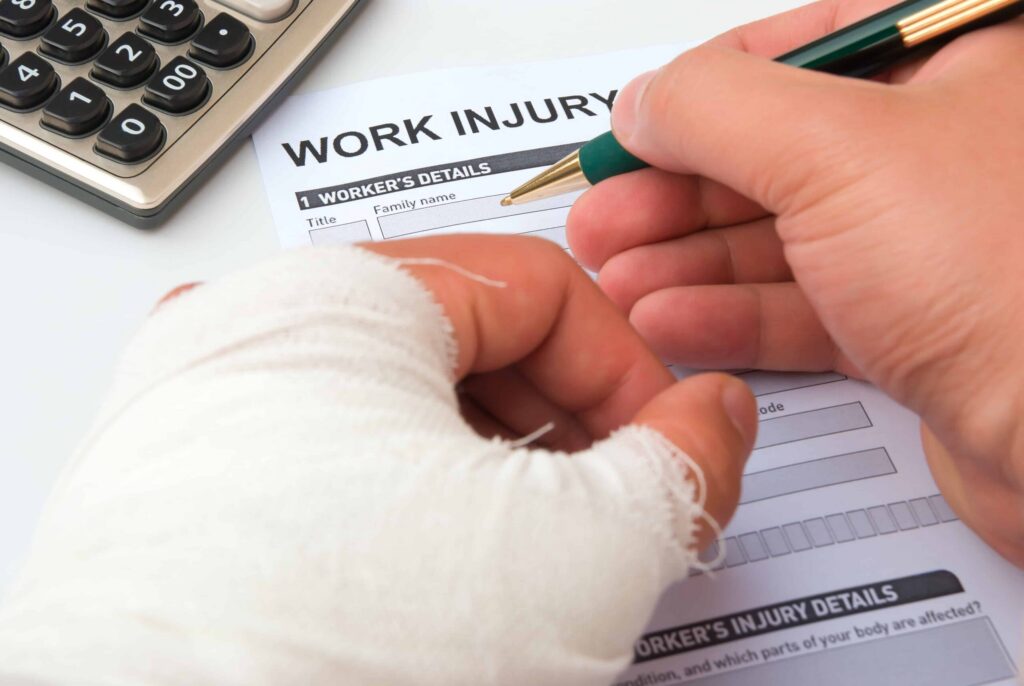
Not before an experienced attorney reads it. A non-subscriber's private injury plan often contains an arbitration clause, a jury trial waiver, or a release, and once you sign, the leverage is gone.
Texas law gives you real protection here, and almost nobody knows about it.
A pre-injury waiver of your right to sue is void under Texas Labor Code §406.033. An agreement you signed at hire, giving up the right to bring a claim, generally cannot be enforced against you.
A post-injury waiver is valid only under narrow conditions. It has to be voluntary, it has to be in writing, it has to be conspicuous and separately signed, you must have received a medical evaluation first, and it cannot be signed earlier than the 10th business day after you first reported the injury.
So if a form was put in front of you in the first days after the injury and it releases your claims, the timing alone may be a problem for the company.
None of this means the plan is worthless. Some pay medical bills promptly and are worth using while a claim is evaluated. The point is that accepting benefits and signing away your case are 2 different acts, and the paperwork does not always separate them. Take photographs and videos of every page and ask before you sign.
What Can You Recover?
Considerably more than a plan pays. A negligence claim against a non-subscribing employer is a personal injury case, and Texas allows the full range of damages.
| Employer injury plan | Negligence claim | |
|---|---|---|
| Medical bills | Usually, on the plan's terms and often with a company-directed doctor | Past and future, your choice of provider |
| Lost wages | Partial, capped, and time-limited | Full past and future lost earnings and lost earning capacity |
| Pain and suffering | No | Yes |
| Physical impairment and disfigurement | No | Yes |
| Fault required | No | Yes, you must prove employer negligence |
| Who controls the case | The plan administrator | You |
For a worker whose shoulder or back injury ends the kind of work they know, lost earning capacity is the largest number in the case and the one a plan never touches.
How Long Do You Have to Act?

Generally 2 years from the date of injury under Texas Civil Practice and Remedies Code §16.003. (*Always speak directly to an attorney for the exact deadlines that apply to your potential claims.) Report the injury in writing to your employer immediately, regardless.
Contact a lawyer as soon as possible after your work injury. Sales floor and receiving dock video is overwritten in weeks. Equipment gets repaired or scrapped. Coworkers who saw it happen move to another club or leave retail.
One more record is worth knowing about. A Texas non-subscriber with 5 or more employees must report certain injuries to the state on a DWC Form-007, and OSHA separately requires most employers to log recordable injuries. Those records exist whether or not anyone shows you.
How These Cases Get Built
Serving Houston Since 1985, Terry Bryant Accident & Injury Law represents injured workers across Texas. Terry Bryant, Former Judge, is board-certified in personal injury trial law by the Texas Board of Legal Specialization.
These cases are proven with the employer's own documents: training records, equipment maintenance and inspection logs, staffing schedules, prior incident reports at the same club, safety audits, and the plan itself. A large retailer has all of it, and none of it arrives voluntarily.
The first conversation is free and entirely confidential, and you pay nothing unless you win your case. For background, our guide on how to read your injury benefits plan walks through the terms that matter most, and the Texas non-subscriber employers hub covers other companies that operate outside the comp system.
Sam's Club Injury Questions
Can I be fired for reporting an injury at work?
Texas prohibits retaliation for filing a workers' compensation claim in good faith, but that protection is built around the comp system and a non-subscriber's employees sit outside it. Other protections can still apply, including federal rules barring an employer from discouraging injury reporting. Keep dated copies of your report and anything added to your file.
The plan sent me to their doctor. Can I see my own?
You can seek your own care, though the plan may not pay for it, and that trade-off is worth discussing before you switch. What matters legally is that a company-selected physician's opinion is not the last word. An independent evaluation frequently reaches a different conclusion about permanent restrictions, and both records end up in front of a jury.
What if a member or a delivery driver caused my injury?
Then you may have a second claim outside the employer entirely. A vendor stocking a display, a delivery driver at the dock, an equipment manufacturer whose pallet jack failed, or a member driving in the lot all carry their own insurance. Those claims are separate from anything the injury plan does, and are often where the meaningful coverage sits.
I am not a full-time associate. Does that matter?
Usually not for a negligence claim. Part-time, seasonal, and temporary workers can bring the same claim, because the duty an employer owes turns on control over the work rather than hours or job title. Workers placed through a staffing agency face an added question about who the legal employer is, and sometimes both companies are on the hook.
My injury built up over months instead of happening in one moment. Do I still have a case?
Possibly. Repetitive strain, back and shoulder degeneration from constant lifting, and hearing loss are real injuries, and a non-subscriber claim does not require a single dramatic event. These cases turn on medical documentation connecting the condition to the work, so the sooner a physician records what your job actually involves, the better.
Find Out Where You Stand Before You Sign
The company already knows whether it carries workers' compensation, what its plan says, and what its records show about the equipment that hurt you. You are the only person in this situation working from incomplete information.
That gap closes with one conversation, and it costs nothing to have.
Call Terry Bryant Accident & Injury Law at (713) 973-8888, or send us the details online. No fee unless you win your case.