Why Are Rear-End Truck Accidents More Serious Than Car Rear-End Crashes?
A rear-end collision by a commercial truck is fundamentally different from a car-on-car rear-end crash because the weight differential, stopping distance requirements, and underride risk create injuries that rarely occur in collisions between 2 passenger vehicles.
Every crash is different. A lawyer can help identify who is responsible and what evidence needs to be secured quickly.
Being rear-ended by a commercial truck and being rear-ended by a car may look similar from the outside. The medical picture that follows is often very different. Mass, momentum, height differentials, and federal safety regulations that don't exist for passenger vehicles all contribute to injury patterns that require a different approach, both medically and legally.
Understanding those differences helps injured people recognize why their claim may be more complex, and more valuable, than a standard car-on-car rear-end case.
Key Takeaways About Rear-End Truck Accidents vs. Car Accidents
- Commercial trucks weigh up to 20 times more than a passenger car, and the physics of that mass differential are the primary driver of injury severity in rear-end truck crashes.
- Rear underride crashes, where a passenger vehicle slides under the back of a truck, cause a distinct category of injuries not typically seen in car-on-car collisions.
- The Federal Motor Carrier Safety Administration (FMCSA) regulations set standards for rear impact guards on commercial trucks under 49 CFR Section 393.86, and violations of those standards can establish negligence in a crash.
- Truck rear-end crashes often involve employer liability alongside driver liability, because federal rules governing hours of service, brake maintenance, and vehicle inspection apply to the carrier, not just the driver.
- Texas law generally allows 2 years to file a personal injury claim under Texas Civil Practice and Remedies Code Section 16.003. (*Always speak directly to an attorney for the exact deadlines that apply to your potential claims.)
Key Statistics About Rear-End Truck Crashes
- In 2023, large trucks accounted for 5% of all registered vehicles, but accounted for 9% of all vehicles involved in fatal crashes, according to National Highway Traffic Safety Administration (NHTSA) crash data. 21% of these fatal truck crashes involved large trucks striking a smaller vehicle from behind.
- 4,150 traffic deaths occurred in Texas in 2024, with commercial vehicle crashes accounting for a disproportionate share of the most severe fatalities, according to the Texas Department of Transportation (TxDOT).
Why Does Vehicle Weight Change Everything in a Rear-End Crash?
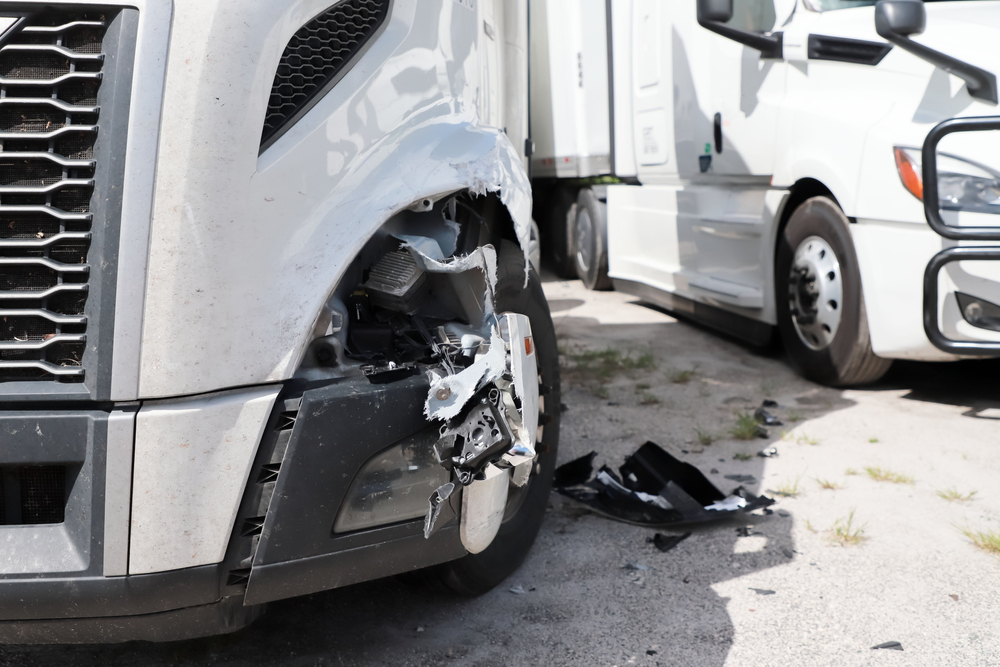
The force of a crash is a product of mass and velocity. When one vehicle weighs 20 times more than another, even a moderate-speed collision transfers an enormous amount of energy into the smaller vehicle. That energy has to go somewhere, and it typically goes into the vehicle structure, the occupants inside, and the restraints meant to protect them.
In a car-on-car rear-end crash at 35 miles per hour, the energy transfer is largely absorbed by crumple zones and seatbelt systems. In a truck-on-car rear-end crash at the same speed, those same systems are overwhelmed by the higher force.
What Types of Injuries Are Common in Rear-End Truck Crashes?
Common Injuries in Rear-End Truck Crashes
| Injury Type | Why It Happens More Often in Truck Crashes |
|---|---|
| Traumatic brain injury (TBI) | Higher-force impact to the head against headrest or airbag |
| Cervical spine and whiplash injuries | Greater acceleration-deceleration forces on the neck |
| Spinal cord injury (SCI) | Compression at greater magnitude than car crashes typically produce |
| Internal organ damage | Seat belt forces at higher impact levels can cause thoracic injury |
| Crush injuries | Rear-end underride can collapse the rear and passenger compartment |
What Is a Rear Underride Accident?
A rear underride occurs when a smaller vehicle slides partially or fully underneath the rear of a commercial truck after a rear-end collision. The truck's cargo deck is typically much higher than the hood of a passenger vehicle, meaning the front of the car can travel under the truck's frame with little structural resistance.
This can result in roof shearing, severe occupant injury even at relatively low speeds, and fatalities that wouldn't occur in a car-on-car crash at the same speed. FMCSA regulations under 49 CFR Section 393.86 require rear impact guards on commercial trailers, but not all trucks comply, and not all guards meet real-world performance standards in a serious crash.
How Is Liability Different in a Truck Rear-End Crash vs. a Car Rear-End Crash?
In a car-on-car rear-end crash, liability typically runs only to the driver of the vehicle that struck from behind. In a truck rear-end crash, the carrier, the company that employs or contracts the driver, is frequently liable as well, and sometimes primarily so.
What Federal Rules Create Additional Liability in Truck Rear-End Crashes?
FMCSA regulations impose specific duties on commercial carriers that don't exist for private drivers.
- Hours-of-service rules limit how long a driver can operate without rest. A fatigued driver who rear-ends another vehicle after exceeding those limits creates liability for both the driver and the carrier that allowed or incentivized the violation.
- Brake performance standards under 49 CFR Part 393 require commercial trucks to meet minimum stopping distance requirements. A truck whose brakes weren't properly maintained may be unable to stop in time even when the driver reacts appropriately.
- Pre-trip inspection requirements under 49 CFR Part 396 require drivers to inspect brake systems before every trip. A failure to catch a known brake problem creates liability for the driver, the carrier, or both.
For more on how carrier insurance requirements affect the value of these claims, see our guide on how much a truck accident settlement is worth in Texas.
Can a Truck Rear-End Case Involve More Than Two Defendants?
Yes. The driver, the carrier company, a cargo owner, and even a maintenance contractor can all share liability depending on the facts. This is one of the core differences between a car rear-end case and a truck rear-end case, the chain of potential defendants is longer, and each party's insurer may take a different position on fault.
For comparison on rear-end car crash claims specifically, see our Rear-End Accident Lawyer page.
What Injuries Require Special Attention in a Truck Rear-End Case?
Cases involving traumatic brain injury (TBI) and spinal cord injury (SCI) deserve specific mention because they often involve ongoing care needs that are easy to undervalue in early settlement offers.

Why Is Traumatic Brain Injury (TBI) Common in Truck Rear-End Crashes?
TBI can occur even when there's no visible head wound, because the brain experiences rapid deceleration inside the skull. Symptoms, memory problems, mood changes, light sensitivity, difficulty concentrating, may not appear immediately, and an insurance adjuster who reviews a case before symptoms fully emerge may argue the injury isn't serious.
What Makes Spinal Cord Injuries (SCIs) Different in Truck Crashes?
SCIs range from herniated discs requiring physical therapy to complete injuries resulting in paralysis. The distinction matters enormously for settlement valuation because the lifetime care costs of a serious spinal cord injury can exceed several million dollars. Cases involving SCIs almost always require independent medical evaluation to establish the long-term care plan before a settlement is agreed to.
When Should You Talk to a Lawyer After a Truck Rear-End Accident?
It's usually worth speaking with a lawyer as soon as possible after a truck rear-end crash, because evidence disappears quickly and early settlement offers are often made before the injury picture is fully clear.
- The crash involved a commercial truck, semi, or tractor-trailer.
- The truck's carrier has already sent a representative or adjuster to contact you.
- Injuries involved the head, neck, or spine.
- The crash occurred at highway speed or resulted in airbag deployment.
Rear-End Truck Accident Questions Answered by Attorneys
I was rear-ended by a semi on the highway, the driver says I cut him off before braking. What happens now?
Fault in rear-end truck crashes is often contested. Trucking carriers investigate quickly. An attorney can request the truck's black box data, which records speed, braking, and engine activity in the seconds before impact, and which often tells a more accurate story than the driver's account.
My car's rear end was crushed and I feel fine right now, should I still see a doctor?
Yes. Symptoms from traumatic brain injury (TBI), spinal injury, and internal injury sometimes appear hours or days after impact. A medical evaluation shortly after the crash creates a documented timeline that protects your claim.
The truck driver's company says their driver's logbook shows he was within his hours, is that the end of it?
Not necessarily. Paper or electronic logs can be falsified. An attorney can subpoena additional records, including GPS data and fuel receipts, that may contradict what a logbook shows.
I've seen ads for a truck company saying it's "award-winning", does that mean they're less likely to be negligent?
No company reputation replaces what the evidence shows about a specific crash. Safety award claims don't change a carrier's legal duties or what the data from that truck's own systems shows.
Is It Always the Truck's Fault in a Rear-End Crash?
Not automatically. If a driver cuts sharply in front of a commercial truck and braked suddenly, the truck driver and carrier may argue that fault is shared. Texas's proportionate responsibility rule applies the same in truck cases as it does in car cases.
What Is the Black Box in a Commercial Truck and Why Does It Matter?
Commercial trucks are typically equipped with an Event Data Recorder (EDR), often called a black box, which captures speed, brake application, engine throttle, and other data in the moments before a crash. This data is among the most valuable evidence in a truck accident case and has a limited retention window.
What If the Truck Doesn't Have a Rear Impact Guard?
Under FMCSA regulations, most trailers are required to have rear impact guards. The absence of a required guard, or the presence of a guard that didn't meet performance standards, can independently establish negligence against the carrier.
How Is the Damage Calculation Different in a Truck Rear-End Case Compared to a Car Case?
The same categories apply, medical bills, lost wages, pain and suffering, but the magnitude is often larger because injuries are more severe, recovery takes longer, and future care needs are more significant. For more on how these cases are valued, see our guide on truck accident settlement amounts in Texas.
What You Can't See Is Often What Matters Most

A rear-end truck crash may not look like a catastrophic accident from the outside. A driver who walks away from the scene may not know for days that they have a cervical disc injury or a concussion. The truck's logbook may look clean while the GPS data tells a different story.
Getting the full picture requires moving quickly, before data is overwritten and before an insurer's early offer frames what the case is worth.
Terry Bryant is Board Certified in personal injury trial law by the Texas Board of Legal Specialization. As a former judge, he knows how these cases are built and how carriers defend them. The Terry Bryant Law Firm has been serving Houston since 1985.
If a commercial truck rear-ended your vehicle in the Houston area, call (713) 973-8888 or toll-free 1 (800) 444-5000 for a free, confidential consultation with our expert Houston truck accident legal team.