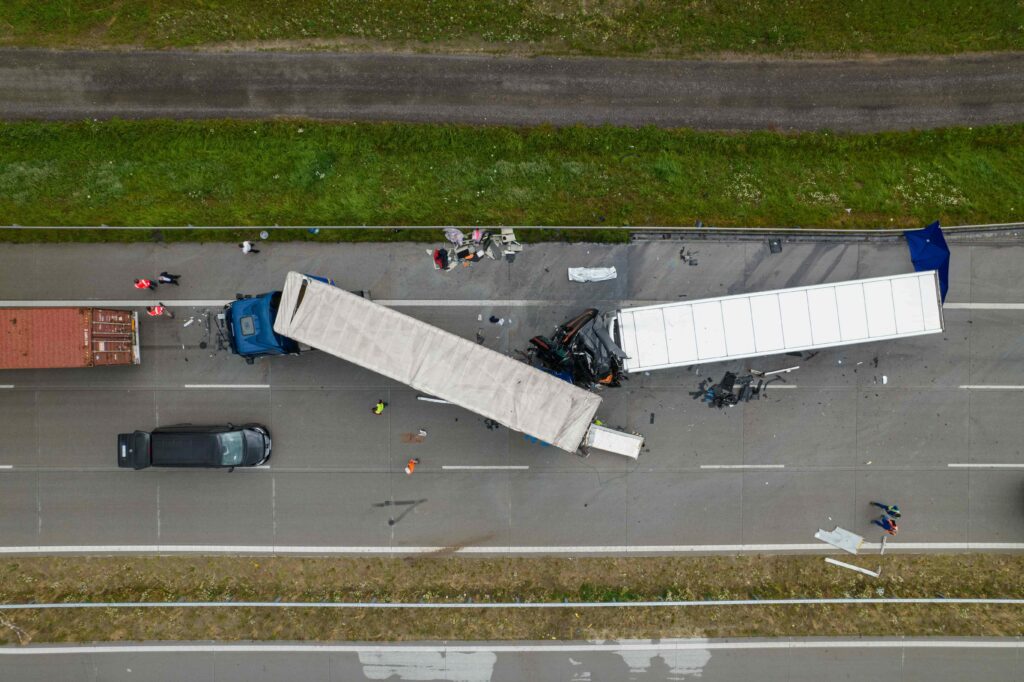
A jackknife truck accident occurs when a tractor-trailer loses traction, and the trailer swings outward at the coupling point, folding the rig into a shape resembling a folding pocketknife. On Houston's major freight corridors, Interstate 10, Interstate 45, Interstate 69, and Beltway 8, a jackknifing 80,000-pound rig can sweep across 3 or 4 lanes of traffic in under 2 seconds, leaving drivers with no time to react.
What makes these crashes uniquely destructive is the physics. Unlike a standard rear-end collision, a jackknife creates a moving wall of steel that can strike multiple vehicles simultaneously, flip onto passenger cars, and block emergency access to the scene for extended periods. The resulting injuries are frequently catastrophic: traumatic brain injuries (TBIs), spinal cord damage, crush injuries, and fatalities are common outcomes.
Understanding who caused the jackknife, and who is legally responsible for it, requires working through a chain of potential liability that most victims never see coming.
My Car Was Hit by a Jackknifing Semi-Truck on I-10 in Houston. Who Do I Sue?
When a semi-truck jackknifes and hits your vehicle, the driver is rarely the only party responsible. In Texas, liability in a jackknife truck accident often extends to the trucking company, the cargo loader, the maintenance contractor, and sometimes the shipper — each of whom may carry separate insurance policies and face independent legal exposure under state law and federal regulations.
- A jackknife accident occurs when a tractor-trailer's cab and trailer fold toward each other at the coupling point, sweeping across multiple lanes in seconds
- Texas law allows injured victims to pursue multiple liable parties simultaneously under modified comparative fault rules
- Federal Motor Carrier Safety Administration (FMCSA) regulations govern how trucking companies operate in Texas and create independent grounds for liability
Every jackknife case in Texas involves its own chain of events and its own chain of responsibility. Speaking with an attorney as early as possible helps identify every party that may owe you compensation.
Where in Houston Are Jackknife Truck Accidents Most Likely to Happen?
Houston's highway system moves more freight than almost any other metro area in the United States. That volume concentrates risk on specific corridors where jackknife accidents occur with predictable regularity.
| Highway / Corridor | Why Jackknife Risk Is Elevated | Common Contributing Factor |
| Interstate 10 (Katy Freeway) | Highest commercial truck volume in Houston, frequent sudden traffic stops | Abrupt braking in congested traffic |
| Interstate 45 South (toward Galveston) | Port of Houston freight corridor, heavily loaded trailer traffic | Overloaded or improperly distributed cargo |
| Beltway 8 / Sam Houston Tollway | High-speed connector between freight hubs, frequent lane changes | Driver error at highway speed |
| Interstate 69 / US-59 | Major north-south freight route through the city | Fatigue on long-haul routes |
| Interstate 610 Loop | Urban freight distribution, tight interchange geometry | Inadequate braking distance in curves |
| Texas State Highway 288 | Growing freight corridor serving the Texas Medical Center area | Newer route with less driver familiarity |
If you were hit by a jackknifing truck on any of these corridors, the specific road conditions, camera coverage, and freight patterns of that route are part of the evidence that an experienced attorney will investigate.
Key Takeaways About Jackknife Truck Accident Liability in Texas
- The truck driver, the trucking company, the cargo loader, the maintenance contractor, and the parts manufacturer can all be independently liable depending on what caused the jackknife
- Texas modified comparative fault rules under Texas Civil Practice and Remedies Code Section 33.001 allow you to recover damages as long as you are found to be 50% or less at fault
- FMCSA regulations create federal safety standards that, when violated, can establish negligence per se against a trucking company or driver
- Trucking companies are required to maintain electronic logging device data (ELD), maintenance records, and driver qualification files — all of which can be critical evidence
- Evidence in jackknife cases disappears quickly: black box data can be overwritten, skid marks fade, and trucks are repaired or returned to service within days of a crash
How Common Are Jackknife Truck Accidents on Texas Roads?
- The Texas Department of Transportation (TxDOT) reports that a person is injured in a vehicle accident involving a commercial truck approximately every 2 minutes in Texas, making the state one of the most dangerous in the country for truck accident victims
- The Federal Motor Carrier Safety Administration (FMCSA) identifies loss of control, which includes jackknife events, as one of the leading causes of fatal large truck crashes nationwide
- Harris County, which includes Houston and its major freight corridors, consistently ranks among the highest-volume commercial truck traffic areas in the United States, putting local drivers at elevated risk of large truck collisions
The volume of freight moving through Houston means jackknife accidents are not rare events. They are a predictable consequence of high-density commercial trucking on urban interstate systems.
What Causes a Jackknife Accident in Texas?
A jackknife does not happen randomly. It is almost always the result of a specific failure, mechanical, human, or both, that an attorney and accident reconstruction expert can identify and trace to a responsible party.
Can Improper Braking Cause a Jackknife?
Yes, and it is one of the most common causes. When a driver applies the brakes too hard or too suddenly, particularly at highway speed, the trailer's wheels can lock before the cab slows down. The momentum of the trailer pushes it sideways, beginning the jackknife. This type of event points directly to driver error, though it may also implicate brake maintenance failures if the anti-lock braking system (ABS) was malfunctioning.
Does Cargo Loading Affect Jackknife Risk?
Significantly. A trailer loaded with uneven weight distribution shifts during braking and cornering, making the trailer far more likely to swing out. Federal regulations under 49 CFR Part 393 set specific standards for how cargo must be secured and distributed. A cargo loader who violates those standards and contributes to a jackknife can face independent liability separate from the driver and the trucking company.
What Role Does Driver Fatigue Play?
A fatigued driver has slower reaction times and is more likely to brake abruptly when encountering traffic ahead. FMCSA regulations for hours-of-service limit how long a commercial driver can operate a vehicle, but violations are common. Texas allows truck drivers to be behind the wheel for up to 11 hours after 10 consecutive hours off duty. When drivers exceed these limits and when trucking companies pressure them to do so, both the driver and the company may face liability.
Which Federal Regulations Apply to Jackknife Truck Accidents in Texas?
Commercial trucking in Texas is governed by both state law and federal regulations that apply to any carrier operating in interstate commerce. When a trucking company or driver violates these rules, that violation can establish negligence per se — meaning the violation itself is evidence of fault without requiring additional proof of unreasonable conduct.
Hours of Service: 49 CFR Part 395
The FMCSA Hours of Service regulations limit how long a commercial driver can operate a vehicle without rest. A driver who exceeded these limits at the time of a jackknife accident, or a company that pressured drivers to violate them, faces direct regulatory liability. Electronic logging device records, required under 49 CFR Part 395.8, document every hour the driver was on duty.
Brake System Requirements: 49 CFR Part 393
The FMCSA equipment regulations at 49 CFR Part 393 require commercial trucks to maintain functioning brake systems, including anti-lock braking systems on trailers manufactured after March 1, 1998. A jackknife caused by brake failure on a truck with documented maintenance deficiencies implicates both the driver and the carrier under these rules.
Cargo Securement: 49 CFR Part 393 Subpart I
Federal cargo securement standards require that all cargo be properly distributed and secured before a truck enters traffic. Improperly loaded trailers that contribute to a jackknife can expose the cargo loader and the carrier to liability under these rules.
Driver Qualification: 49 CFR Part 391
The FMCSA driver qualification regulations require carriers to verify that every driver they put on the road holds a valid commercial driver's license, has passed required medical examinations, and does not have a disqualifying driving history. A company that ignores a driver's prior accidents or license violations when hiring faces negligent hiring liability under these standards.
Vehicle Inspection Requirements: 49 CFR Part 396
FMCSA inspection and maintenance regulations require carriers to systematically inspect, repair, and maintain all vehicles. Driver pre-trip inspection reports are required before every trip. A truck that jackknifed because of a known mechanical deficiency that was documented and ignored represents one of the clearest liability scenarios in commercial truck litigation.
Who Is Actually Liable in a Texas Jackknife Truck Accident?
This is the question most accident victims ask first, and the answer is rarely simple. Texas law allows multiple parties to share liability for the same accident, and jackknife cases almost always involve more than one responsible party.
Is the Truck Driver Liable?
The driver is frequently the starting point for liability analysis. A driver who braked improperly, was fatigued, was speeding, or was distracted at the moment of the jackknife may be personally liable for the resulting injuries. However, in most commercial trucking arrangements, the driver alone does not carry enough insurance to compensate victims for catastrophic injuries, which is why identifying additional liable parties matters so much.
When Is the Trucking Company Liable?
The trucking company faces liability on multiple independent grounds in most jackknife cases.
Under the legal doctrine of respondeat superior, a Latin term meaning "let the master answer," an employer is responsible for the negligent acts of its employees committed during the course of employment. If the driver was an employee of the trucking company at the time of the crash, the company is liable for the driver's negligence.
Beyond respondeat superior, the trucking company may face direct negligence claims for negligent hiring if the driver had a problematic record the company ignored, negligent supervision if the company failed to enforce hours-of-service rules, and negligent maintenance if the truck's brakes, tires, or coupling equipment were not properly maintained.
| Trucking Company Liability Theory | What Must Be Proven |
| Respondeat superior | The driver was an employee acting within the scope of employment |
| Negligent hiring | The company hired a driver with known disqualifying history |
| Negligent supervision | The company failed to monitor or enforce driver compliance with regulations |
| Negligent maintenance | The company failed to inspect or repair equipment that contributed to the jackknife |
| Negligent entrustment | The company allowed an unqualified driver to operate the vehicle |
What If the Driver Was an Independent Contractor?
Trucking companies sometimes classify drivers as independent contractors specifically to create distance from liability. Texas courts and federal regulations have increasingly scrutinized this classification. If the trucking company exercised control over the driver's routes, schedule, or conduct, a court may find that the driver was effectively an employee regardless of how the contract was worded.
Can the Cargo Loader Be Held Liable?
Yes. If the jackknife was caused or worsened by improper cargo loading, the company responsible for loading the trailer may share liability. This is particularly relevant in Houston, where port-related freight operations, warehouse loading facilities, and third-party logistics companies are frequently involved in the chain of custody for goods moving through the region.
Is the Truck Manufacturer or Parts Maker Liable?
When a mechanical defect contributed to the jackknife, faulty ABS, defective trailer brakes, or a coupling failure, the manufacturer of the defective component may face product liability claims under Texas law. These claims exist independently of any negligence by the driver or company.
Can the Shipper Be Responsible?
In some cases, yes. If a shipper provided instructions for loading cargo that contributed to a weight imbalance, or if the shipper knew the cargo presented unusual risks and failed to disclose them, the shipper may share in the liability chain.
What Does the Liability Chain Look Like in a Real Houston Jackknife Case?
Consider a scenario that plays out regularly on Houston's freight corridors. A refrigerated trailer loaded with goods from the Port of Houston is moving westbound on I-10 near Katy. Traffic slows suddenly. The driver, who has been on the road for 10 hours after falsifying his electronic logging records, brakes hard. The trailer's brakes, which had a known deficiency documented in the last inspection report but never repaired, lock up. The trailer swings left across 2 lanes and crushes a sedan.
Here is what the liability chain looks like in that scenario:
| Party | Why They May Be Liable | Evidence That Establishes It |
| The truck driver | Falsified ELD records, improper braking technique | ELD data, black box braking inputs, driving history |
| The trucking company | Knew about brake deficiency, failed to repair it, failed to supervise hours | Maintenance records, inspection reports, dispatch records |
| The cargo loader | Overloaded the trailer beyond federal weight limits | Weight tickets, cargo manifests, federal inspection records |
| The brake manufacturer | Manufactured a defective brake component | Component testing, FMCSA recall records, maintenance history |
| The shipper | Directed loading in a way that violated cargo distribution rules | Loading instructions, shipper contracts, cargo manifests |
No single attorney call fixes all of this. But an attorney who knows where to look, and who sends preservation letters within 24 hours of being retained, can secure the evidence that makes each piece of this chain visible to a jury.
What Does Texas Law Say About Multiple Liable Parties?
Texas uses a modified comparative fault system, meaning that each party's percentage of fault is determined by the jury, and damages are reduced accordingly. Under Texas Civil Practice and Remedies Code Section 33.001, a plaintiff who is found to be more than 50% at fault cannot recover any damages.
What Is the "51% Rule" in Texas Truck Accident Cases?
The 51% rule means that if a jury finds you were 51% or more responsible for the jackknife accident, you recover nothing. This is the primary argument that trucking company defense lawyers use to reduce or eliminate compensation; they attempt to shift a portion of fault to the victim. An experienced attorney anticipates this tactic and builds the case to establish that the trucking company and driver bear the overwhelming share of responsibility.
Does Texas Allow Victims to Sue Multiple Defendants at Once?
Yes. A victim of a jackknife accident in Texas can name the driver, the trucking company, the cargo loader, the maintenance contractor, and the parts manufacturer in the same lawsuit. Each defendant's share of fault is determined separately, and each may be required to pay their proportionate share of damages.
What Evidence Is Critical in a Texas Jackknife Liability Case?
Identifying all liable parties requires evidence that begins disappearing within hours of the crash. This is one of the primary reasons why contacting an attorney immediately after a jackknife accident is not just advisable, it is often the difference between a strong case and a compromised one.
What Is the Black Box and Why Does It Matter?
Commercial trucks are required to carry electronic control modules, commonly called black boxes, that record speed, braking inputs, engine RPM, and other data in the seconds before a crash. This data can confirm whether the driver was speeding, whether the brakes were applied correctly, and how the vehicle behaved during the jackknife sequence. Black box data can be overwritten within 30 days or less if the truck returns to service.
What Are FMCSA Records and How Are They Used?
The FMCSA requires trucking companies to maintain driver qualification files, hours-of-service logs recorded on electronic logging devices or ELDs, vehicle inspection reports, and maintenance records. These records can reveal whether the driver was over hours, whether the brakes had outstanding maintenance issues, and whether the company had prior notice of safety problems. An attorney can send a spoliation letter, a formal legal notice, requiring the trucking company to preserve these records immediately.
Why Do Skid Marks and Road Evidence Disappear?
Skid marks on the pavement, debris fields, fluid patterns, and gouge marks in the road surface are all physical evidence of how the jackknife unfolded. Rain, traffic, and road crews can eliminate this evidence within days. An accident reconstruction expert who photographs and measures the scene early can preserve this evidence in a form that holds up in court.
What Compensation May Be Available After a Texas Jackknife Truck Accident?
Texas law allows victims of jackknife truck accidents to pursue both economic and non-economic damages.
What Are Economic Damages in a Texas Truck Accident Case?
Economic damages are quantifiable financial losses directly caused by the accident. They include past and future medical expenses, lost wages during recovery, loss of future earning capacity if the injuries are permanent, costs of rehabilitation and long-term care, and property damage to the vehicle.
What Are Non-Economic Damages?
Non-economic damages compensate for losses that do not have a fixed dollar value but are real and significant. They include physical pain and suffering, emotional distress, loss of enjoyment of life, and loss of consortium for a spouse or family member affected by the victim's injuries.
Is There a Cap on Damages in Texas Truck Accident Cases?
Texas does not cap economic or non-economic damages in personal injury cases against private trucking companies. Caps on non-economic damages apply in medical malpractice cases but not in standard truck accident litigation.
What Does the Trucking Company Do in the First 24 Hours After a Jackknife Crash?
Within minutes of a serious jackknife accident, the trucking company's insurer is notified. What happens next is something most victims never see — and it directly affects the strength of any future legal claim.
Hour 1: The Rapid Response Team Is Dispatched
Large trucking companies and their insurers maintain rapid response teams specifically for serious accidents. These teams include attorneys, accident reconstruction specialists, and investigators. Their job begins before you leave the hospital. They photograph and record footage of the scene, measure skid marks, interview witnesses, and begin building a version of events that protects the company.
Hours 2 to 12: Evidence Is Documented on Their Terms
The rapid response team documents the scene from the perspective of the defense. They are not gathering evidence to help you. They are gathering evidence to establish that the driver followed proper procedures, that the truck was properly maintained, and that your own actions contributed to the crash.
Hours 12 to 48: The Insurance Adjuster Makes Contact
Within 1 to 2 days, the trucking company's insurance adjuster will often contact the victim directly. The call is friendly, and the adjuster sounds helpful. The purpose of the call is to obtain a recorded statement before the victim has spoken with an attorney themselves. That statement can be used to limit or deny the claim.
What this means for you: Every hour that passes without an attorney on your side is an hour the trucking company's team is working without opposition. Terry Bryant Accident & Injury Law can respond immediately to a jackknife accident in Houston — call (713) 973-8888 or toll-free 1 (800) 444-5000 now. We are here for you 24/7/365.
When Should You Talk to a Jackknife Truck Accident Lawyer in Houston?

Immediately. Not after the insurance adjuster calls. Not after you feel better. The moment you are physically able to make a call, or a family member is able to make one on your behalf, is the right time.
Trucking companies send rapid response teams, lawyers, investigators, and accident reconstruction specialists to major crash scenes within hours. Their job is to gather evidence and build a defense before you have had a chance to speak with anyone. An attorney who can respond equally as quickly can take steps to preserve evidence, identify all liable parties, and ensure that the trucking company's rapid response does not go unanswered.
Ask Terry Bryant Accident & Injury Law
Q: A semi-truck jackknifed on I-10 and hit my car. The trucking company's insurance has already called me. Should I talk to them? A: Do not give a recorded statement or accept any offer from the trucking company's insurer before speaking with an attorney. Insurance adjusters for trucking companies are trained to gather information that can be used to reduce or deny your claim. Once you give a recorded statement, you cannot take it back. Contact Terry Bryant Accident & Injury Law at (713) 973-8888 before responding to any insurer.
Q: The truck driver was an independent contractor. Does that mean the trucking company is off the hook? A: Not necessarily. Texas courts and federal regulations look at the actual relationship between the company and the driver, not just how the contract is labeled. If the company controlled the driver's routes, schedule, or conduct, it may still face liability. An attorney can investigate the full nature of the relationship and determine whether the independent contractor classification holds up.
Q: How long do I have to file a lawsuit after a jackknife truck accident in Texas? A: Texas law generally gives you 2 years from the date of the accident to file a personal injury lawsuit under Texas Civil Practice and Remedies Code Section 16.003. However, preserving evidence requires acting far sooner than that. Black box data can be overwritten within weeks, and physical evidence at the scene disappears quickly. Contacting an attorney as soon as possible after the accident protects both your evidence and your legal rights. (*Always speak directly to an attorney for the exact deadlines that apply to your potential claims.)
Q: The jackknife accident was partly my fault, according to the police report. Can I still recover damages? A: In many cases, yes. Texas uses a modified comparative fault system, meaning you can still recover damages as long as you are found to be 50% or less at fault. Your damages would be reduced by your percentage of fault. Trucking company defense lawyers often try to argue that victims bear more fault than they actually do — an experienced attorney like Terry Bryant can counter those arguments with the evidence needed to establish the true allocation of responsibility.
Q: My injuries are serious, and I cannot afford medical care right now. What can I do? A: Terry Bryant Accident & Injury Law handles truck accident cases on a contingency fee basis, meaning you pay no attorney fees unless you win your case. The Terry Bryant Law firm also works with medical providers who treat accident victims on a lien basis, meaning treatment is provided now, and the provider is paid from the eventual settlement or verdict. You do not have to delay medical care because of financial concerns.
Jackknife Truck Accident Questions Answered
What is the first thing I should do after a jackknife truck accident in Houston?
Call 911 and seek medical attention even if your injuries do not seem serious at first. Adrenaline and shock can mask symptoms of significant injuries, including traumatic brain injuries (TBIs) and internal damage, that may not become apparent until hours or days later. A medical evaluation creates a record connecting your injuries to the accident, which is critical for any future legal claim.
Can a jackknife truck accident case settle without going to trial?
Many do. The strength of the evidence, the clarity of liability, the severity of injuries, and the willingness of the trucking company's insurer to negotiate all affect whether a case resolves before trial. However, trucking companies with powerful insurance carriers do not always settle fairly without the credible threat of trial. An attorney who is prepared to take a case to a jury is generally in a stronger negotiating position than one who routinely settles.
What if the trucking company's insurance policy is not enough to cover my damages?
Commercial trucking companies operating in Texas are required by federal law to carry minimum liability coverage of $750,000 dollars for general freight carriers, and many carry policies of $1 million dollars or more. However, catastrophic injuries can produce damages that exceed even large policies. In those situations, pursuing all liable parties, the driver, the company, the cargo loader, and any others in the chain, becomes essential to maximizing recovery.
How does Mr. Bryant's firm investigate a jackknife truck accident?
Terry Bryant Accident & Injury Law works with accident reconstruction specialists, FMCSA compliance experts, and medical professionals to build the evidence needed for a strong claim. The investigation includes obtaining black box and ELD data, reviewing driver qualification files and hours-of-service records, examining maintenance logs, and identifying all parties in the liability chain.
You Were in the Wrong Place. The Truck Driver and Company Made the Wrong Choices.

A jackknife accident does not happen to you because of bad luck. It happens because someone in the chain, a driver who braked too hard, a company that skipped a maintenance check, a cargo loader who ignored federal weight distribution rules, made a decision that put your life at risk.
At Terry Bryant Accident & Injury Law, Terry Bryant and his team have spent over 4 decades all across Texas, holding trucking companies accountable for exactly those decisions. The Terry Bryant Law firm operates on a simple principle: you pay nothing unless we win.
If you or someone you love was injured in a jackknife truck accident in Houston or anywhere in Texas, call (713) 973-8888 or toll-free 1 (800) 444-5000 or visit our website for a free, confidential case review. The trucking company's rapid response team is already at work — you should be too.